Vodafone UX Schedule
Vodafone wanted a UX schedule defining that would allow them to see whether their SEO strategy was working, and could also inform a long-term content strategy.
THE BRIEF
I was asked to write an initial overview of a UX schedule that could fulfil the client's needs. They required a way to monitor traffic to online articles that would confirm their SEO strategy. They also wanted to be able to create a content strategy they could use in the future.
INVESTIGATION
When I came to this task, the client didn't have an SEO strategy. They were coming to the end of a period in which they were quickly filling what they perceived as a content gap by writing a large number of short-form articles for their online hub. There was no input from their SEO team.
It also became apparent that they were not monitoring website traffic very closely and were operating by a few vague guidelines that seemed to be based on assumptions (such as: "our customers prefer short-form content") with no data to back them up.
Traffic was being directed to new articles via advertisements, leading to 95% of the page traffic to come from referrals. When the advertising period ended, traffic was dropping off abruptly.
In order to drive internal change, the client wanted a way to monitor whether SEO was having a positive impact on organic traffic.
QUANTITATIVE TESTING
The client had GA4 in place, but weren't clear on what metrics they were monitoring. I suggested, as a starting point, that they monitored traffic breakdown (direct, organic, referral), return visitors, and scroll depth per page.
Dividing articles into four groups (with and without SEO, plus with and without advertising support) would start to create an essential overview of how SEO was affecting traffic.
I also suggested using a heatmap tool such as Hotjar to allow a more in-depth view at scroll depth and click-tracking.
In addition to this, I thought that on-page testing might offer some insight into what visitors wanted to see. I expected conversion of a 'was this page helpful?' button to be low, but to offer a general insight over time.
QUALITATIVE TESTING
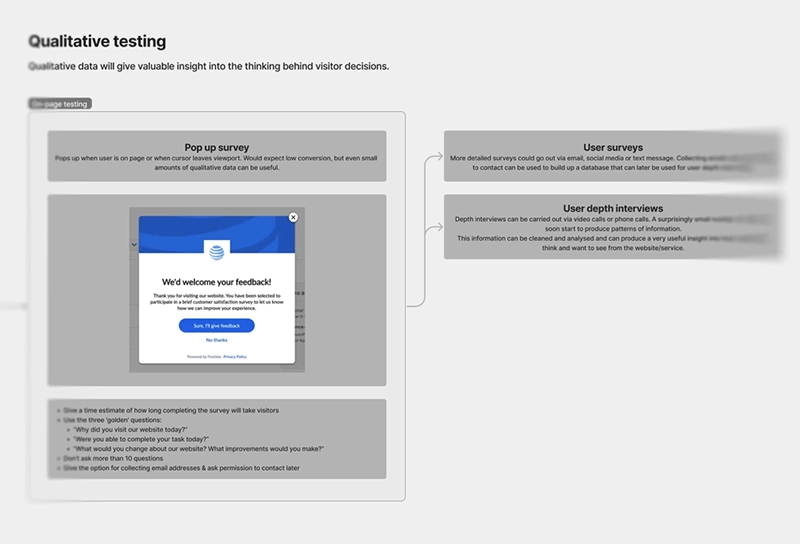
As well as using quantitative data to test SEO impact, I also suggested it would help the client to begin qualitative testing to build up an idea of who their customers were.
A pop-up survey on the page may not have great conversion, but with a large user base, it wouldn't be long before they started getting useful information.
Data from user surveys could then be fed into user depth interviews, which could provide even more insight into what users wanted to get from the article hub. This information could then be used to inform a content strategy.
CONCLUSION
The overall goal for this project was to provide an initial guide to the client as to how they could set up a schedule for quantitative testing and possible qualitative testing in order to monitor a new SEO strategy and eventually develop a content strategy.
I created a diagram that laid out how these things could work and submitted it to the client, along with notes clarifying some points in the diagram.
The client approved the UX schedule immediately and booked meetings with the in-house UX team to integrate the new schedule with their existing duties.